
Cost to Build a Deck in Augusta, ME: The 2026 Numbers
A line-by-line breakdown of what a deck costs in Augusta, Maine, by size and by material, with the footings, framing, railing and stairs priced separately.
Pressure-treated starts at $80 a square foot and complicated layouts run $100 to $120. Composite carries a $15,000 floor against pressure-treated's $10,000, because the board is the smaller part of the difference and the frame under it is the same either way.
The guide exists mostly to correct one assumption. A smaller deck is not a cheaper deck per foot, because six footings cost about the same whether they hold up 96 square feet or 200. The size-by-size table is where that becomes obvious.
- 25+ years in construction, building as Newman Homes since 2017
- Over 200 projects completed in Central Maine
- Affordable work, two-year written warranty
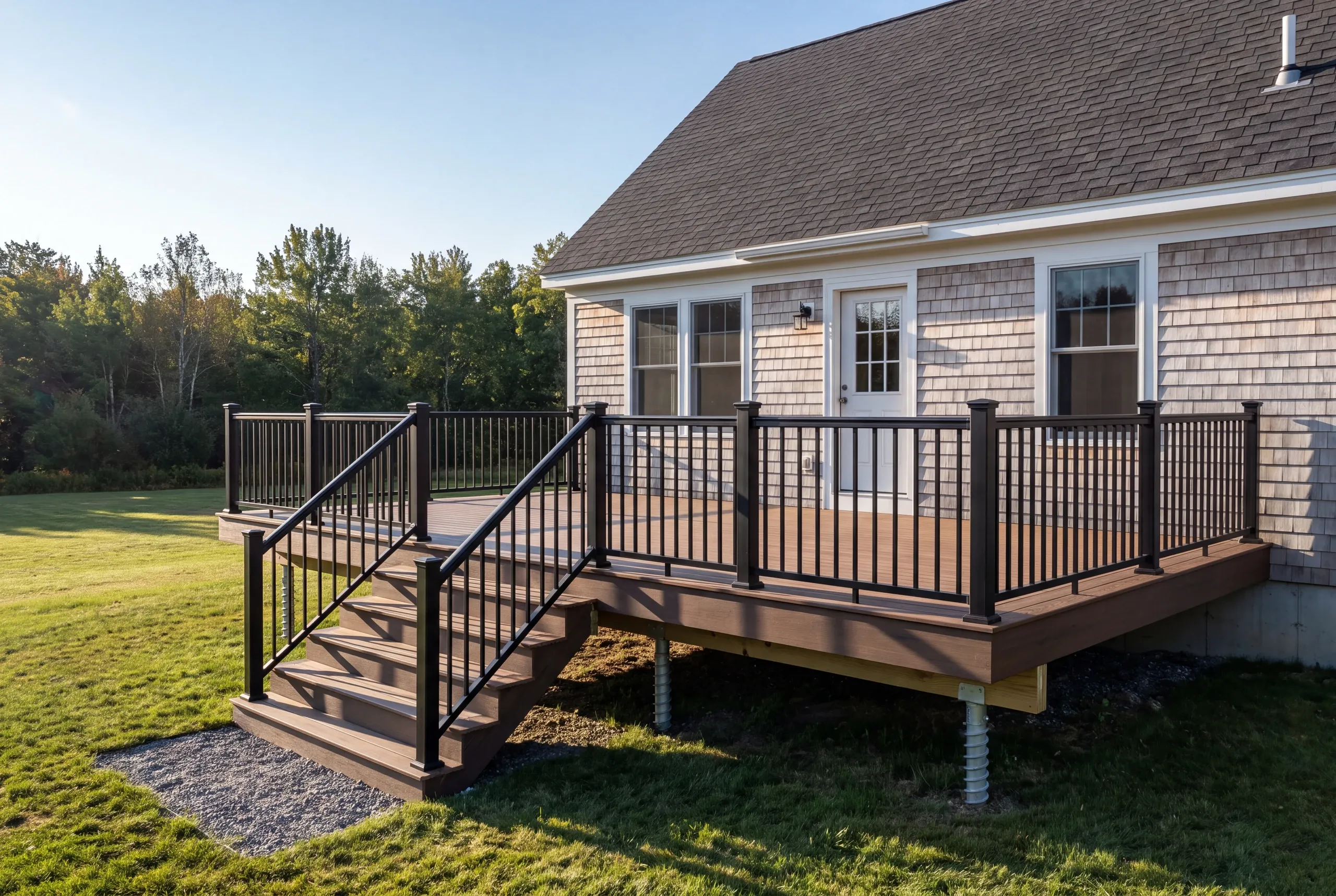
The cost to build a deck in Augusta, ME starts at $80 per square foot for an all pressure-treated build, turnkey with railing, and reaches $100 to $120 on larger or more complicated layouts.
Updated for 2026.
The most useful thing on this page is not the rate. It is the reason a small deck costs more per square foot than a big one, which is the opposite of what almost everybody assumes.
If you want the build itself rather than the budget, what goes into a deck is on its own page.
The Rates
| Scope | Figure |
|---|---|
| All pressure-treated, new build | $80 per square foot |
| Larger or more complicated layouts, shapes, and tie-ins | $100 to $120 |
| Project floor, all pressure-treated | $10,000 |
| Project floor, composite decking with composite railing | $15,000 |
Towns farther out, on camp roads, on ledge, or with tight urban staging carry up to 10% above those figures. Augusta itself sits at the base rate.
Each band is an average across hundreds of quotes rather than a bid for any particular deck.
Cost to Build a Deck in Augusta, ME by Size
| Deck | Pressure treated | Composite |
|---|---|---|
| 8x12 (96 sq ft) | about $9,800 with stairs | $15,000 floor |
| 12x16 (192 sq ft) | about $10,800 | $15,400 |
| 16x20 (320 sq ft) | $25,600 to $32,000 if complex | $28,000 and up |
| 20x24 (480 sq ft) | $38,400 to $48,000 if complex | $42,000 and up |
Look at the first two rows again. That is the whole point of this guide.
Small Decks Cost More Per Foot
Footings are close to a fixed cost. An 8x12 pressure-treated deck with stairs and six footings runs about $9,800.
A 12x16 costs roughly $1,000 more and delivers exactly twice the deck.
So going bigger is cheap per square foot, and shrinking a design almost never saves what people expect it to. If the budget is tight, the honest advice is usually to build the size you want and simplify the shape.
Height works the same way. Getting more than about 2 feet off the ground adds roughly one crew day for staging, and that day is the same on a 3-day build as on a 12-day one, so the percentage hit is far larger on a small deck.
What Moves the Number
- Stairs, and how many runs. Each set of stairs is framing, treads, railing, and a landing.
- Shape. Angles, curves, and multiple levels are all labor rather than material.
- Height off the ground, past roughly 2 feet.
- Whether usable footings already exist, which sometimes they do and often they do not at the right depth.
- Tie-in to the house, and whether a ledger is even the right approach.
- Railing choice. Aluminum, composite, and cable all price differently, and railing is a bigger share of a small deck than a large one.
One local line item worth knowing: Waterville and some southern Maine towns set the deck permit fee as a percentage of total project price. On a large deck that is real money and it should appear on the estimate rather than as a surprise.
What a Deck Should Be Built To
The spec below is what separates a deck that lasts from one that gets rebuilt in fifteen years. Ask any bidder to confirm each line.
- Footings to 4 feet, full frost depth. Helical piles on most jobs, because they go in clean and do not need the hole to stay open.
- Joists 16 inches on center, and 12 inches under PVC, which spans differently and telegraphs a soft frame.
- Joist tape on every joist. The fastener holes are where a frame rots first.
- Hidden clips, face-screwed and plugged on PVC because PVC moves with temperature.
- Flashing at the ledger, always. A ledger without flashing is the most common serious defect we find on an existing deck.
- Trim so no end grain shows. End grain drinks water.
Three things nobody should accept: floating deck blocks, an unflashed ledger, and new decking laid over an old frame.
Framing, ledger connection, and guard requirements are set out in the residential code, and the ledger section is worth reading yourself before you sign anything.
Wood or Composite
Pressure treated is the cheapest way to get a deck and it needs maintenance you will actually have to do. By two decades it is done, and the tell is an owner who has already replaced individual dangerous boards.
Composite and PVC cost more up front and almost nothing after. TimberTech and AZEK are what we specify first, with Deckorators mineral-based as an emerging option and Trex on request. Span and fastening requirements are published by the manufacturer.
Railing is where the look gets decided. Westbury aluminum is our default, with TimberTech Radiance Rail as the composite alternative.
The composite project floor is $15,000 rather than $10,000, which means composite rarely makes sense on a very small deck and usually makes sense on a large one.
Common Questions
Can you build on my existing footings?
Sometimes. Depth, condition, and spacing all matter, and the frame is what everything else depends on, so it is worth an honest answer rather than a hopeful one.
Do I need a permit for a deck in Augusta?
Generally yes for a structure attached to the house or above a height threshold. The city's code office decides, and we file the application.
How long does a deck take?
Three days to two weeks for most projects, driven by size, height, and stair count.
Why helical piles?
They reach full depth cleanly, they work in wet ground where a poured hole collapses, and they can go in when a poured footing would have to wait.
Get a Real Number
Maine has no state licensing standard for deck builders, so the written scope is the protection. Ask for footing depth, joist spacing, joist tape, and the ledger detail in writing, plus a fixed price under Maine's home construction contract law.
Brandon takes the calls at (207) 480-7700. Email info@newmanhomesme.com, or book a free estimate.